It's that time of year when we carry out the essential renovation work on the greens.
Many of our members despair when we start this, but I will run through the reasons why it is so essential.
1. Golf is the only sport played on turf that does not have a closed playing season. All other sports:- Football, Tennis, Bowls, Cricket etc have a large window of opportunity to carry out the essential work that is needed following a seasons play.
2. Compaction, thinning out of the surfaces, thatch build up and sickly Annual meadow grass can all be dealt with during this renovation work.
3. Ideally, this work is carried out in the height of the growing season (August) to speed up recovery, but due to fixtures and the levels of summer play the work is pushed into September.
4. We need warmth in the soil to aid seed germination and help the recovery process.
We start by solid tining the greens to a depth of 300mm with 12mm diameter tines. In the past we have used larger tines, but these have proved too disruptive for the time of year.
We then deep scarify the greens with 3mm wide blades using a pedestrian Graden machine to a depth of 20mm. The debris is blow off the surface and removed. This leaves the grooves open to receive the seed (Bent & Fescue) which is then covered with pure sand dressing.
The dressing is then dragged and brushed into the surface to smooth and bury the seed to protect it during germination.
We then roll the greens repeatedly to again smooth and restore the surfaces.
It is then up to mother nature and the weather to do their stuff.
I know this work is disruptive but the greens have improved year on year following this programme of improvements. Without this, thatch and compaction would build up and disease and Annual meadow grass would become real issues on the greens.
Wednesday, 18 September 2013
Tuesday, 2 July 2013
Questions and Feedback on the blog.
Following a Greens Committee meeting it has been decided that the blog will go back to it's original purpose of informing the membership of current events and work on the course.
This decision does not intend to stop members expressing their opinion on course related issues. Members can write to The Captain or Greens Chairman as in the past, and their queries will be dealt with promptly.
Tuesday, 25 June 2013
Recent comments
Following the recent micro-tining & top-dressing and the resulting negative comments, I thought they deserved a reply.
The greens have been slow to improve this year due to the really late spring and low temperatures. We are not the only courses which have been affected, as even many of the coastal links courses are behind their normal recovery rates.
The perception that all we have to do is cut the greens for them to have good surfaces is wrong. Mowing helps a great deal, but is always carried out in conjunction with rolling, verti-cutting, aeration and top-dressing. The more you cut and roll the more remedial work you have to carry out. St. Annes Old links were today deep tining their greens to a depth of 250 mm!
If you copy & paste the link below you will be able to read our Agronomists (Robert Laycock) report from May this year.
http://www.mangc.co.uk/Laycock%20Report%20May%202013.pdf
The comment about "20 years of talk about Bent & Fescues has come to nothing" is also incorrect. 10 years ago there were no fine grasses in the greens at Hopwood. Now some of our greens have over 50%. The issue in the spring is that the weedy Poa Annua is slow to recover from the winter, while the finer species recover quickly. It is the Poa that causes the uneven surfaces.
On Sunday morning before the Hulbert Trophy the course was saturated following heavy overnight rain. The greens were dry and free from puddles allowing us to mow and prepare the course for the comp. The reason for this was the micro-tining we carried out the week before allowing the water to pass through the soil profile quickly.
Following the very wet year last year, the rough grew very thick and caused problems in the playability of the course. Problem areas were identified and the rough was cut back. These area have been continued to be cut this year, with a lot of extra width on the 2nd, 3rd, 6th, 9th, 10th, 14th, 15th & 17th holes. More work is being carried out at the moment to thin out any other problem areas and it is hoped to keep these area down through the season.
I can understand members frustrations with lost balls and slow play, but modern technology in golf tends to concentrate on distance and not accuracy.
As for the comment that the course is in "poor condition", this I cannot accept and I know of many members & visitors who have expressed their pleasure in enjoying the Hopwood experience.
Congratulations Ken on winning Captains 4th round last Saturday with a 67!
The greens have been slow to improve this year due to the really late spring and low temperatures. We are not the only courses which have been affected, as even many of the coastal links courses are behind their normal recovery rates.
The perception that all we have to do is cut the greens for them to have good surfaces is wrong. Mowing helps a great deal, but is always carried out in conjunction with rolling, verti-cutting, aeration and top-dressing. The more you cut and roll the more remedial work you have to carry out. St. Annes Old links were today deep tining their greens to a depth of 250 mm!
If you copy & paste the link below you will be able to read our Agronomists (Robert Laycock) report from May this year.
http://www.mangc.co.uk/Laycock%20Report%20May%202013.pdf
The comment about "20 years of talk about Bent & Fescues has come to nothing" is also incorrect. 10 years ago there were no fine grasses in the greens at Hopwood. Now some of our greens have over 50%. The issue in the spring is that the weedy Poa Annua is slow to recover from the winter, while the finer species recover quickly. It is the Poa that causes the uneven surfaces.
On Sunday morning before the Hulbert Trophy the course was saturated following heavy overnight rain. The greens were dry and free from puddles allowing us to mow and prepare the course for the comp. The reason for this was the micro-tining we carried out the week before allowing the water to pass through the soil profile quickly.
Following the very wet year last year, the rough grew very thick and caused problems in the playability of the course. Problem areas were identified and the rough was cut back. These area have been continued to be cut this year, with a lot of extra width on the 2nd, 3rd, 6th, 9th, 10th, 14th, 15th & 17th holes. More work is being carried out at the moment to thin out any other problem areas and it is hoped to keep these area down through the season.
I can understand members frustrations with lost balls and slow play, but modern technology in golf tends to concentrate on distance and not accuracy.
As for the comment that the course is in "poor condition", this I cannot accept and I know of many members & visitors who have expressed their pleasure in enjoying the Hopwood experience.
Congratulations Ken on winning Captains 4th round last Saturday with a 67!
Thursday, 20 June 2013
Ongoing Maintenance
Managing a golf course and its surfaces is not just about cutting grass. We often get criticised for "messing around" with the greens, when we are in fact carrying out essential work to maintain surfaces.
On Monday we started micro-tining the greens to alleviate compaction which builds up following continued mowing & rolling. This allows the turf to breathe and lets moisture pass thru the profile and away from the surfaces. The tining is not disruptive and following mowing, the surfaces are restored and in many cases improved.
We also apply pure sand as a top-dressing. This again prevents the surfaces becoming capped (improving drainage) and fills any small depressions in the surface smoothing them out. Since we purchased our new dresser the process has been much quicker and recovery quicker.
I would ask the members to be patient during any periods of this work as it really is essential in maintaining and improving our greens.
On Monday we started micro-tining the greens to alleviate compaction which builds up following continued mowing & rolling. This allows the turf to breathe and lets moisture pass thru the profile and away from the surfaces. The tining is not disruptive and following mowing, the surfaces are restored and in many cases improved.
We also apply pure sand as a top-dressing. This again prevents the surfaces becoming capped (improving drainage) and fills any small depressions in the surface smoothing them out. Since we purchased our new dresser the process has been much quicker and recovery quicker.
I would ask the members to be patient during any periods of this work as it really is essential in maintaining and improving our greens.
Friday, 7 June 2013
Compost Tea.
Over the last 6 months you will have seen me mention Compost tea. 2 1/2 years ago the club decided to purchase a Compost Tea brewer to produce our own soil conditioning liquids.
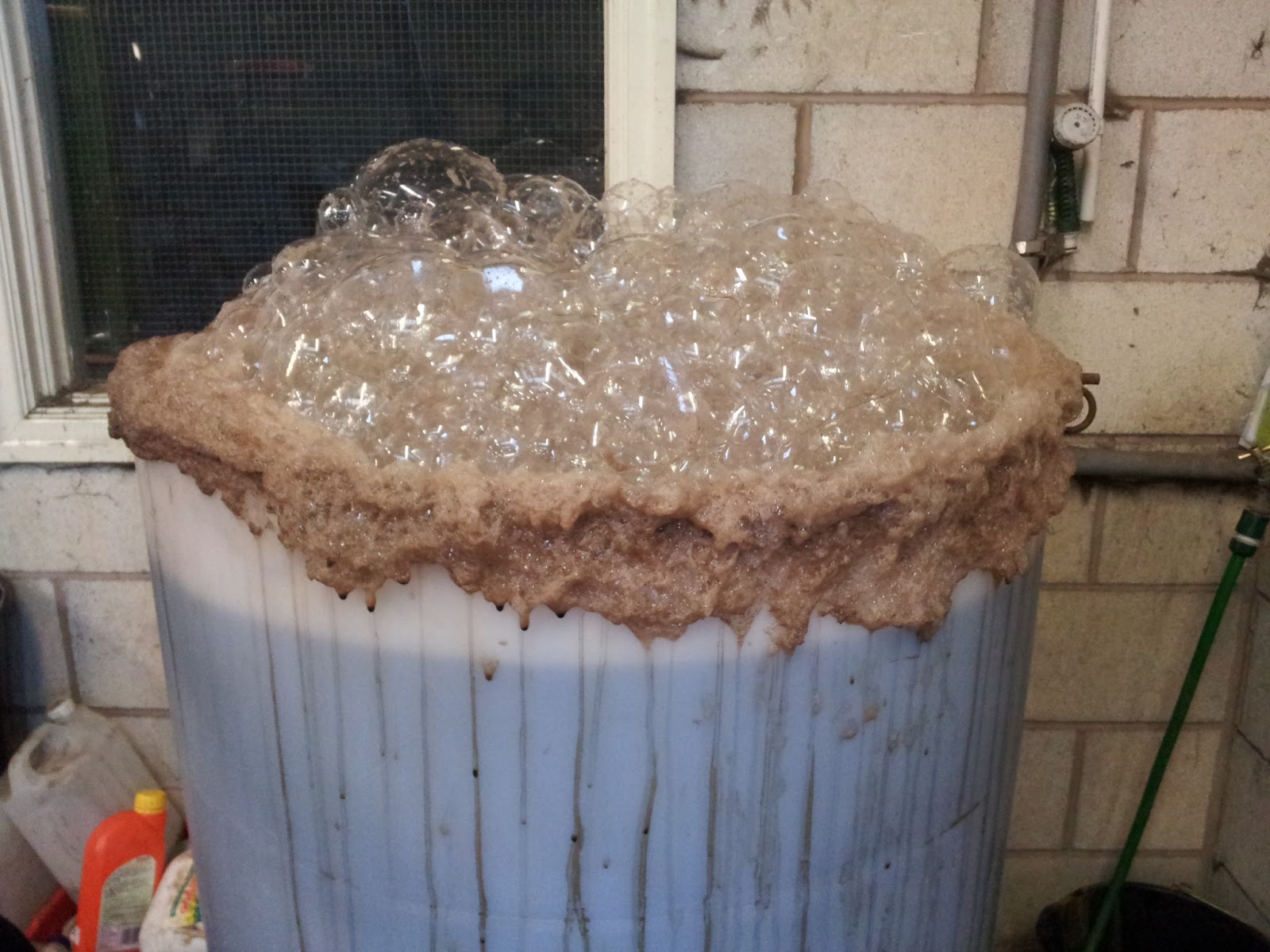
The brewer consists of a cylindrical plastic tank which holds over 200 L of water. Attached to this is an air pump which aerates the liquid from the bottom.
We fill the tank with water and then aerate it for 30 minutes to remove any chlorine. We then add a large Tea bag which is filled with compost and granular seaweed. As well as this we pour small quantities of Humic acid, Fish Hydroslate and molasses.
The brew is left to bubble away for 48-72 hours. As you can see from the photo, the solution gets quite lively. This is because the natural microbes and funghi in the liquid start to multiply. Both of these give the soil a much needed boost and help reduce thatch buildup, increase resistance to disease and reduce toxins in the soil. They also help release trapped nutrients in the soil.
We then add the solution to a sprayer with a further 400 L of water and apply it to the greens. The cost of each tank is around £70. When you consider that a single application of fungicide can cost as much as £750, you can see the potential savings are huge.
The organic way has always had many benefits and compost tea helps us maintain a natural management programme.
The brewer consists of a cylindrical plastic tank which holds over 200 L of water. Attached to this is an air pump which aerates the liquid from the bottom.
We fill the tank with water and then aerate it for 30 minutes to remove any chlorine. We then add a large Tea bag which is filled with compost and granular seaweed. As well as this we pour small quantities of Humic acid, Fish Hydroslate and molasses.
The brew is left to bubble away for 48-72 hours. As you can see from the photo, the solution gets quite lively. This is because the natural microbes and funghi in the liquid start to multiply. Both of these give the soil a much needed boost and help reduce thatch buildup, increase resistance to disease and reduce toxins in the soil. They also help release trapped nutrients in the soil.
We then add the solution to a sprayer with a further 400 L of water and apply it to the greens. The cost of each tank is around £70. When you consider that a single application of fungicide can cost as much as £750, you can see the potential savings are huge.
The organic way has always had many benefits and compost tea helps us maintain a natural management programme.
Tuesday, 4 June 2013
Northern Counties
The greenstaff have been putting the hours in to get the course ready for the EGU Northern Counties tournament. The weather over the last 5 days has been fantastic and really helped speed along our preparations. The greens have come on leaps and bounds, with the poa annua smoothing out its growth pattern. The bunkers have dried out and the sand has loosened again due to the lack of moisture bonding the particles. This is a direct consequence of the previous wet summers washing out the faces and contaminating the sand with fine soil particles. It's hoped to start correcting this next winter and also reduce the height of some of the faces.
Sunday, 26 May 2013
Growth!
Well Spring has sprung at last. The course is showing real signs of growth in all areas at last. The meadow grass in the greens is finally catching up with the bent grass and the surfaces are smoothing out. Of course, this also meant that the weedy poa was struck by Fusarium patch disease, which meant I had to spray the greens for the 1st time in 18 months. We couldn't risk the disease spreading with the Northern Counties event just around the corner.
We have continued to verti-cut lightly and we again will apply a light sand dressing this week to further smooth the surfaces and the height of cut will be brought down ready for the big day.
Lets hope the sun continues to shine so we can all enjoy the course.
We have continued to verti-cut lightly and we again will apply a light sand dressing this week to further smooth the surfaces and the height of cut will be brought down ready for the big day.
Lets hope the sun continues to shine so we can all enjoy the course.
Subscribe to:
Comments (Atom)